Open Educational Resources (OER) are a transformative tool in higher education, offering equitable access to learning materials and empowering students and educators alike. By reducing the financial burden of costly textbooks, OER fosters a more inclusive educational environment, ensuring that all students—regardless of their financial background—have access to high-quality learning resources. The Michelson Spark Grants funding cycle aims to further advance this vision by supporting innovative projects that scale OER implementation, build capacity, and enhance outreach.
The OER Spark Grants funding cycle will open for proposals from March 3rd – 17th.
Focus Areas
During this cycle, we seek to fund projects that support systems-level strategies with potential to create positive impact at scale and inform public policy. Our focus areas include:
Supporting the implementation of California’s investment in zero textbook cost (ZTC) degree programs within the California Community College (CCC) system.
Mobilizing students and faculty to pass OER policies at the University of California (UC), CCC, and California State University (CSU) systems.
Improving the quality and reach of OER marketing materials, particularly for under-resourced programs at institutions nationwide.
Researching and conducting public education around automatic textbook billing, with a focus on student experience and consumer protection.
Investigating the impacts of textbook billing and accessibility state and federal policies.
Funding Cycle Details
The program provides a just-in-time grantmaking process to fill urgent needs for higher education organizations that are aligned with our focus areas. The Spark Grants Program is available to United States-based nonprofits. Projects with a national scope must impact California. Additionally, proposals where Michelson Spark Grant funds are part of a larger overall project with multiple funding streams are welcomed.
Join Us to Learn More
Join members of the grant committee on February 20th to learn more about the focus areas and funding opportunity. Join Senior Program Manager Cailyn Nagle and Director of Programs and Operations Ryan Erickson-Kulas on February 20, 2025, for an informational webinar. During it, they will provide an in-depth overview of the Spark Grants program, highlight past awardees, and share detailed updates on the student basic needs funding cycle.
View the Recording
Missed the webinar? A recording is available below:
Just like the Little Black Dress (LBD), which has been a wardrobe essential for decades, foundational strategies in the open educational resources (OER) community are equally timeless and effective. While the silhouette, material, and styling has shifted with eras, the Little Black Dress remains a wardrobe-building keystone. Shifting from a conference presentation to an event gala context requires swapping out shoes and accessories, the LBD allows effortless transitions between day and night. As technology, governments, and society shifted the LBD remained. Sometimes, the classics are classics for a reason. Sometimes there’s nothing wrong with returning to a time-trusted foundational piece.
Factors Contributing to the Decrease in OER Awareness
For the first time since Bay View analytics began reporting on OER awareness, fewer faculty knew about or used OER materials. The dip was small, but it marked a change in an over a decade-long trend. Contributing factors include administrators taking control of materials assigned in courses. In the past, Bay View has reported on the increasing number of administrators who are playing a larger role in deciding which course materials will be used. Another factor is the increasing prevalence of automatic textbook billing. Advocates and practitioners should push against these factors, but they are long-term battles. We can also make daily impacts through the choices and tactics we use in our programs. Like the LBD, the OER community can revisit and refresh some of the trusted basics.
Recruitment: An Eternal Effort
As a community organizer, I learned another acronym: ABC or Always Be (re)Cruiting. Due to natural attrition, the volunteer pool would eventually dry up without a steady flow of new people. Along with dedicated recruitment drives throughout the year, recruitment was also an ongoing process. We cast a wide net with strong marketing and outreach, including follow-up and onboarding year-round, and incorporating recruitment across all activities.
Ways to Increase OER Capacity and Resources
OER community, bandwidth, capacity, and resources often limit the ability to incorporate these strategies. Not every OER program has the capacity to knock on the faculty doors, hold one-on-one conversations, or access customizable OER marketing materials. There is no quick fix for capacity, but the Michelson 20MM Foundation has included the creation of marketing and outreach materials in this year’s OER Spark Grant focus areas. We hope grants will provide the resources programs need to create and share those materials.
Consistent new members means organizing creates engaging experiences for long-time volunteers while welcoming and orienting newcomers. Volunteer activities, from door knocking to panel events, begin with a baseline explanation of goals and training. New attendees can follow along, even if 90% of the crowd are experienced volunteers. Some OER events and conferences have stepped back from strong 101 programming in favor of advanced conversations on pedagogy, deep research, and other fascinating topics. Deeper engagement is needed, but our community must also extend a ladder to new members. These new OER-curious practitioners need to build the knowledge base that strengthens our movement.
Understanding What Motivates the OER Community
What are axioms but the reiteration of a classic concept into a memorable phrase? In “Axioms of Organizers,” community organizer Fred Ross Sr. quipped: “It’s the way people are that matters, not the way you’d like them to be.” In the OER world, community members often share what inspires and motivates them about open education. For some, it’s creating culturally responsive materials. For others, it’s the blurring of the lines between student and educator through the active knowledge creation of open pedagogy. For others, it is the global collaboration OER enables.
These are strong motivators, but when growing our movement, we must focus the messaging on what motivates the gatekeepers of policies and resources. A recent report from Ithaka’s Dr Ioana Hulbert, Deirdre Harkins, and Dr. Mark McBride, “Charting the Course-Case Studies in OER Sustainability,” offers insights on how OER programs can build, thrive, and survive. One key finding speaks to Ross’ axiom, “OER initiatives flourish when they align with institutional priorities and are framed as a tool that can address several goals beyond affordability, such as advancing equity, access, or instructional innovation.”
This often means identifying existing priorities for institutional leaders and tailoring OER messaging to what speaks most clearly to them. This concept holds true beyond courting administrators focused on completion rates or legislators concerned with student savings. The OER community must strategically shift focus to recruit and build the movement—from student government leaders to bookstore managers to department heads.
A Timeless Reminder to Step Back and Focus on Our Goals
Truth be told, I have six little black dresses. They include a gold beaded one from the 1980s with a matching bolero jacket, a simple eyelet one from the Gap, and an A-line beatnik with pink trimming from the 1960s. Basics are meant to be built upon and improved, but we never truly move past them. When unsure of my next steps, I step back, focus on my goals, and remember my three-letter fundamentals.
About Michelson 20MM
Michelson 20MM is a private, nonprofit foundation working toward equity for underserved and historically underrepresented communities by expanding access to educational and employment opportunities, increasing affordability of educational programs, and ensuring the necessary supports are in place for individuals to thrive. To do so, we work in the following verticals: Digital Equity, Intellectual Property, Smart Justice, Student Basic Needs, and Open Educational Resources (OER). Co-chaired and funded by Alya and Gary Michelson, Michelson 20MM is part of the Michelson Philanthropies network of foundations.
Open Educational Resources (OER) provide equitable access to learning materials, empowering both students and educators. By reducing the financial burden of expensive textbooks, OER fosters a more inclusive educational environment. They can help ensure that all students, regardless of financial background, have access to high-quality learning resources.
The 2025 OER Michelson Spark Grants funding cycle furthers these positive impacts. It does so by supporting innovative projects that scale OER implementation, build capacity, and enhance outreach.
2025 Open Educational Resources Focus Areas
In order to drive a scalable impact within the communities we serve, the funding cycle emphasizes the following areas:
Supporting the implementation of California’s investment in zero textbook cost (ZTC) degree programs within the California Community College (CCC) system.
Mobilizing students and faculty to pass OER policies at the University of California (UC), CCC, and California State University (CSU) systems.
Improving the quality and reach of OER marketing materials, particularly for under-resourced programs at institutions nationwide.
Researching and conducting public education around automatic textbook billing, with a focus on student experience and consumer protection.
Investigating the impacts of policies relating to textbook accessibility, OER, and textbook price transparency at the state and federal level.
Meet the Spark Community Advisors
The Michelson 20MM Foundation believes that those closest to the issues we’re working on understand a community’s needs best and are closest to the solution. With this in mind, we are proud to introduce a remarkable group of advisors whose expertise will shape strategies that promote equity, support vulnerable populations, and drive innovative approaches to improving OER.
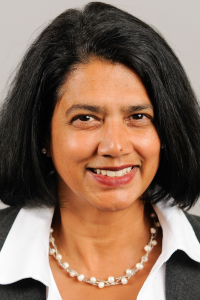
Elaine Correa, Ph.D | Professor and Chair, California State University, Bakersfield, Department of Human Development, and Child, Adolescent, and Family Studies
Dr. Elaine Correa earned her Ph.D. in Administration and Policy Studies in Education from McGill University, Montreal, Canada. She joined California State University, Bakersfield (CSUB) in Fall 2016. Dr. Correa serves as Professor and Chair of the Department of Human Development, and Child, Adolescent, and Family Studies. In 2019-2020, she was Interim Associate Dean for the School of Social Sciences and Education. Dr. Correa participates in shared governance on the Academic Senate. She serves on the Academic Support and Student Services Sub-Committee.
In Fall 2023, Dr. Correa spearheaded CSUB’s first OER degree. Her department received recognition from the Chancellor’s Office as one of three CSUs to offer an OER degree program. This initiative addresses equity gaps and increases graduation rates.
Dr. Correa advocates for social justice and community engagement. Her research and work focuses on educational equity, OER/OEP, multiculturalism, feminist pedagogy, e-learning, and service learning.
Paola Santana (she/her/Ella) | Executive Director, Glendale College Foundation
Paola Santana is the Executive Director of the Glendale College Foundation. There, she builds public awareness and collaborates with a 34-member board. Together they raise funds for student scholarships, college programs, and other critical needs.
Previously, Santana served as a Strategy Officer and Grant Maker at Lumina Foundation. In her role, she supported state efforts to increase postsecondary attainment across the nation. Santana also led UNITE-LA’s college access and success portfolio for nearly a decade. She implemented direct service college access programming and developed the organization’s higher education policy advocacy agenda. Santana began her career advising the Los Angeles Unified School District Board of Education on complex policy issues.
She is a graduate of several leadership programs, including the Riordan Leadership Institute and the Pahara NextGen Network. A first-generation, community college transfer student, Santana earned her associate degree at Glendale Community College, baccalaureate degree at the UC, Berkeley, and Master’s in Higher Education at the Harvard Graduate School of Education.
Katie Wagman (she/her) | Senior, University of California, Los Angeles
Katie Wagman is a fourth-year undergraduate at the University of California, Los Angeles (UCLA), studying public affairs. She is a Policy Intern with EveryLife Foundation for Rare Disease and as a Housing/Communications Policy Intern at Strategic Actions for a Just Economy (SAJE).
Previously, Wagman was a Student Fellow for Michelson 20MM’s Textbook Affordability initiative. She worked to ensure students have equitable access to the course materials. She continues this work as the Director of Access and Equity for the undergraduate Academic Affairs Commission. In her role, Wagman is advancing textbook affordability through the UC system and implementing course marking and price transparency at UCLA. Nationally, she advocated for policy changes in the Department of Education.
Upon graduation, Wagman plans to work in housing or healthcare policy, with a particular interest in reproductive healthcare.
This Michelson Spark Grants funding cycle plays a crucial role in driving OER adoption. It empowers communities to overcome barriers to education through affordable learning materials. Together, we can continue creating an equitable educational landscape for students and educators alike.
About Michelson 20MM
Michelson 20MM is a private, nonprofit foundation working toward equity for underserved and historically underrepresented communities by expanding access to educational and employment opportunities, increasing affordability of educational programs, and ensuring the necessary supports are in place for individuals to thrive. To do so, we work in the following verticals: Digital Equity, Intellectual Property, Smart Justice, Student Basic Needs, and Open Educational Resources (OER). Co-chaired and funded by Alya and Gary Michelson, Michelson 20MM is part of the Michelson Philanthropies network of foundations.
As in previous years, the Open Educational Resources (OER) initiative focused on ensuring every student has the opportunity to succeed, free from high course material costs. In 2024, we supported the rollout of Governor Newsom’s $115 million investment in Zero Textbook Cost degrees, worked to protect students within the textbook marketplace, and remained committed to building a higher education system where every student has what they need to thrive.
Conducting Surveys and Original Research
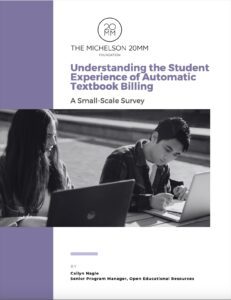
In line with the push to incorporate student feedback and perspectives, the OER program produced a survey on students’ experiences with automatic textbook billing. More than half of students, consistent with surveys from other organizations, felt that automatic textbook billing programs cost more than they saved.
The survey found that most students remained in automatic billing programs because it was the quickest option and they didn’t know where to buy materials outside of the program. One student said, “It felt like more hassle to opt out than to pay out of pocket.” The survey also found that only one in 10 students prefer automatic billing, while over 40% prefer to find materials from off-campus sources.
This survey aimed to start a conversation and invite further research on student preference. It also encouraged institutions to pause before enrolling students in programs to which they have not consented.
Expanding the Student Fellows Program
Michelson 20MM Student Fellows present their work at OpenEd 2024
Katie Wagman, now a senior at the University of California, Los Angeles, (UCLA) remained an OER fellow. She was joined by Abba Schwartz, who transferred from Sierra College to the University of California (UC) Berkeley during the fellowship.
As with last year, the fellowship centered on each student developing and running a local campaign focused on their program areas. Katie continued her advocacy, both on campus and nationally, to focus on student consumer protection in policies about automatic textbook billing. Katie gave public comment during the Department of Education negotiated rulemaking process and was published in the Hill. At UCLA, she worked with the library and campus bookstore to conduct a faculty survey. The survey aimed to better understand faculty views on textbook affordability initiatives and the newly expanded automatic textbook billing program.
Abba’s project was focused on publicizing and expanding the visibility of the California Community College’s (CCC) Zero Textbook Cost (ZTC) Program. Abba worked with the ZTC Technical Advisor’s office and the Academic Senate’s OER Initiative (OERI) Committee to design and launch a “Good News” portal for ZTC success stories. She also created materials for CCC Student Basic Needs offices to publicize ZTC degree options to the students.
Building Community
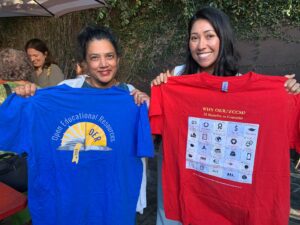
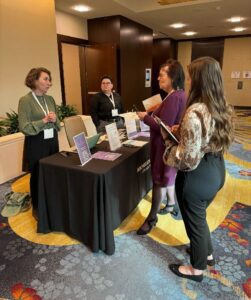
Mayra Lombera, Michelson 20MM’s CEO, (right) with Elaine Correa (left), who traveled from CSU Bakersfield to connect with fellow advocates. Correa self-funded t-shirts on her campus to drive awareness about the benefits of OER.
Southern California is a region rich with higher education institutions. In Los Angeles County alone, there are over 30 colleges and universities. Despite this density, OER educators often feel siloed in their work and interests. To build a stronger OER movement and community in Southern California, Michelson 20MM launched two OER gatherings. These happy hour events allowed faculty, administrators, course designers, and others to gather, network, and share success and resources.
Our first event, Hitting the Books, was held in North Hollywood to mark the start of the term. Educators from as far away as San Diego and Bakersfield joined us for an evening of good food and community. At the start of December, we hosted “OER: The Gift that Keeps Giving,” our second happy hour of the year in Torrance. Educators took a break from preparing for finals and grading end of term essays to celebrate their hard work and spend time in community. We are excited to hold more OER Happy Hour events in 2025!
Welcoming the Spark Grant Recipients
The 2024 OER Spark Grants funding cycle focused on supporting the data and research side of the ZTC program within the CCC system and supporting student organizing at the UC system. Both Chabot College and Glendale Community College are now in the middle of their research and data collection projects, with Chabot building a data dashboard and Glendale CC focused on ZTC course marking visibility. We were also thrilled to support GenerationUP, a student-run grassroots organization, in launching a textbook affordability campaign within the UC system.
Outside of the Spark Grant cycle, the OER program teamed up with the Michelson 20MM Smart Justice Program to jointly support the work of the Transformative Collective Institute in training CCC educators whose students are incarcerated on how to leverage OER in their unique context. Last but not least, we were excited to help support the Student PIRGs’ newest report on automatic textbook billing contracts.
Attending Coast-to-Coast Conferences
The OER team joined the Association of Community College Trustees National Legislative Summit
From Washington, D.C., to the Bay Area, the Michelson 20MM OER team had the opportunity to be in community with educators across the country.
Starting off the year with community colleges from around the nation, we joined the Community College National Legislative Conference in Washington, D.C. During the summer, we attended the CalOpen conference, where we had the opportunity to dig in on the open community in the Golden State. October took the team to New England then the Midwest, with first the Open Education Conference in Providence, Rhode Island, then to the Education Funders Conference in Minneapolis.
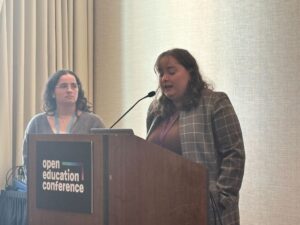
OpenEd’s first hybrid conference since 2019 gave OER Fellows Abba and Katie an opportunity to uplift the work of students in the textbook accessibility space. Abba and Katie presented the work of the Michelson 20MM Student Fellows program and shared insights on how OER practitioners can work alongside students in the field. Katie then joined students from across the country in SPARC’s panel on students pushing back on the spread of automatic textbook billing.
As 2025 approaches, we look back with gratitude on the work of partners and friends. We are also looking forward to continuing to build a world where every student has access to the materials they need to reach their goals.
About the Michelson 20MM Foundation
Michelson 20MM is a private, nonprofit foundation working toward equity for underserved and historically underrepresented communities by expanding access to educational and employment opportunities, increasing affordability of educational programs, and ensuring the necessary supports are in place for individuals to thrive. To do so, we work in the following verticals: Digital Equity, Intellectual Property, Smart Justice, Student Basic Needs, and Open Educational Resources (OER). Co-chaired and funded by Alya and Gary Michelson, Michelson 20MM is part of the Michelson Philanthropies network of foundations.