At the Michelson 20MM Foundation, we believe that advancing open educational resources (OER) requires collaboration with the people closest to the work. That is why we are proud to introduce the 2026 OER Spark Community Advisors, a group of leaders who bring a variety of critical perspectives to help shape this year’s funding cycle.
2026 OER Focus Areas
As the OER landscape continues to evolve, so too must the strategies that support it. This year, we are interested in supporting projects that:
California-Specific
Support the implementation of California’s historic investment in the Zero Textbook Cost degree program in the California Community College (CCC) system.
Projects that build on ZTC degrees beyond the CCC system.
Projects that mobilize student, faculty, and/or staff participation in passing OER and textbook affordability policies at the UC, CCC, and/or CSU systems. In addition, projects that activate or incorporate member-based organizations representing campus communities, including professional, civic, and labor organizations.
National, Inclusive of California Projects
Research and public education around student consumer protection in the textbook marketplace, including automatic textbook billing/equitable access programs, price transparency, and student data privacy with a focus on student experience.
Research investigating the impacts of textbook affordability and access policies at the state and federal level, including OER funding, course marking, student consumer protection, price transparency, sustainability, and supporting educators adopting or creating OER.
Meet the Advisors
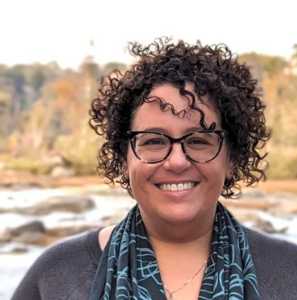
Heather Blicher is the Director of the Community College Consortium for OER (CCCOER) with Open Education Global, where she leads efforts to expand and support open education across community and technical colleges in North America. With more than 20 years of experience in public and academic libraries, her work has focused on teen programming, online learning, OER, instructional design, and equity-centered initiatives. Heather believes in the power of storytelling to build stronger, more connected communities.
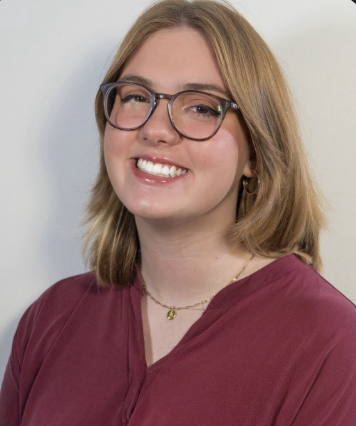
Ryan Coryea brings a critical student voice to the advisory group. As a senior studying Political Science at UC San Diego and Vice Chair of the Campaign for Quality in Resources and Education in the UC Student Association, Ryan advocates for increased adoption of OER within the UC system.
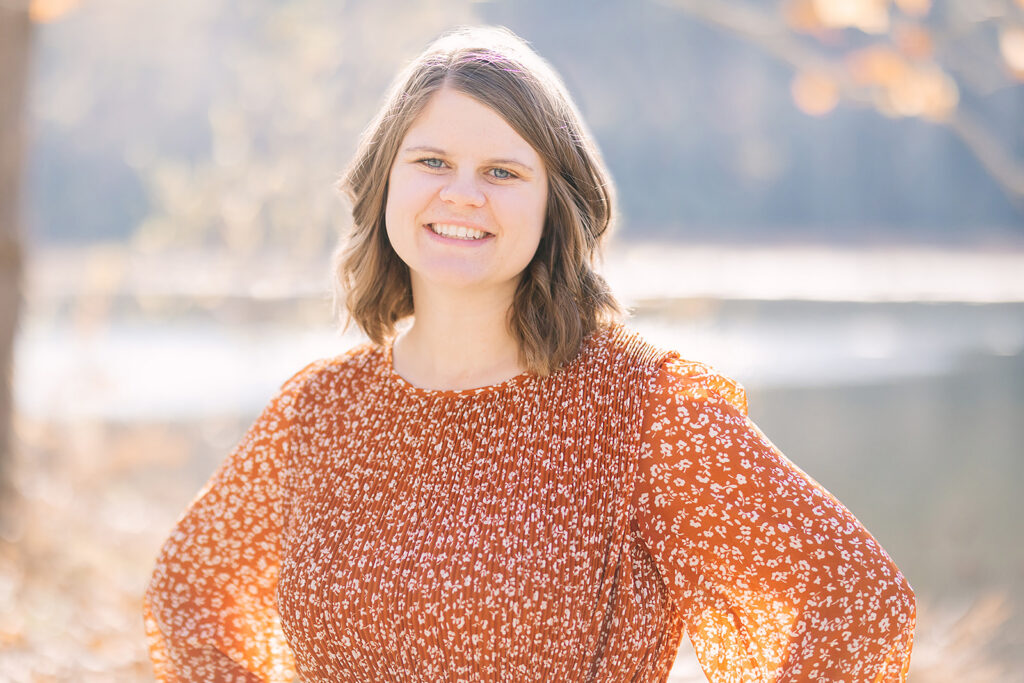
Sarah Hare is the OER Librarian at UC Santa Cruz, where she partners with faculty to make course materials and homework platforms more effective and affordable. Sarah is currently researching how course materials impact UCSC students’ sense of belonging in the classroom. She leads the UC Common Knowledge Group on OER and has previously developed fellowship programs and conducted research on OER and open education.
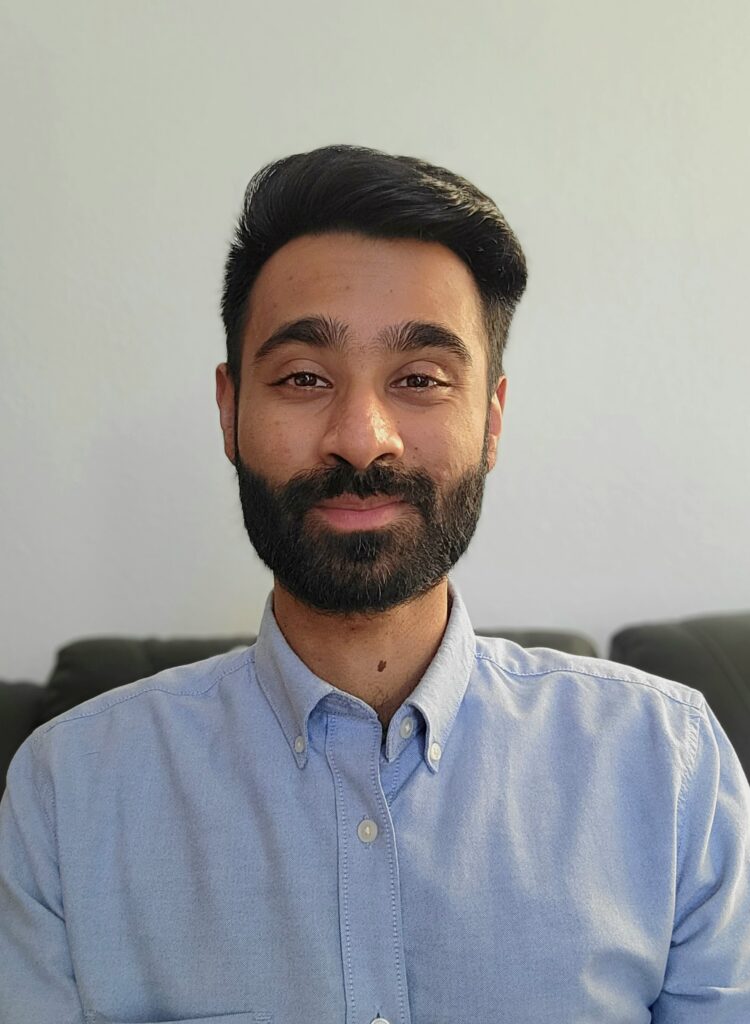
Alex Karan is a Research Analyst at Chabot College and a 2024 OER Spark Grant recipient. In his work, he prioritizes equity for marginalized communities, often working to understand the structural components that relate to and close equity gaps. He received his Bachelor of Arts in Psychology from UCLA and his PhD in Psychology from UC Riverside.
Strengthening the OER Ecosystem
Together, this year’s Spark Community Advisors reflect the collaborative, cross-sector approach needed to advance OER work. From shaping funding priorities to providing insight on emerging challenges and opportunities, their perspectives will help ensure that the OER Spark Grants continue to support impactful, scalable solutions.
As we look ahead, we remain committed to investing in initiatives that expand access to affordable, high-quality course materials and strengthen pathways to student success. The guidance of our advisors is essential to this work and to building a more equitable higher education system.
About Michelson 20MM
Michelson 20MM is a private, nonprofit foundation working toward equity for underserved and historically underrepresented communities by expanding access to educational and employment opportunities, increasing affordability of educational programs, and ensuring the necessary supports are in place for individuals to thrive. To do so, we work in the following verticals: Digital Equity, Intellectual Property, Smart Justice, Student Basic Needs, and Open Educational Resources (OER). Co-chaired and funded by Alya and Gary Michelson, Michelson 20MM is part of the Michelson Philanthropies network of foundations.
The Michelson 20MM Foundation is committed to promoting programs and policies that advance the proliferation and adoption of open educational resources to improve the affordability of instructional materials, efficacy of faculty instruction, and equitable access to educational opportunities. The foundation was launched over a decade ago when a simple news article of qualified community college students dropping out due to the cost of textbooks moved Dr. Gary K. Michelson to first provide immediate help, and then to address the issue at scale.
Since then, we continue to make investments in this work through our Michelson Spark Grants program. The 2026 Open Educational Resources Spark Grants funding cycle will open on March 2nd and close on March 16th. During this cycle, we seek to fund projects that strengthen and scale OER and Zero Textbook Cost degree pathways through implementation, research, public awareness, and policy efforts that improve student access, success, and affordability in California and nationally.
The Michelson 20MM Open Educational Resources (OER) Initiative aims to eliminate the cost of learning materials as a barrier to student success. We work to rebalance the educational content market and shift stakeholder culture toward a new steady state where the quality, prevalence, and utilization of open educational resources has effectively eliminated the cost of learning materials as a barrier to student success.
Funding Cycle Focus Areas
We are interested in supporting projects that advance:
California-Specific
Support the implementation of California’s historic investment in the Zero Textbook Cost degree program in the California Community College (CCC) system; This can include but is not limited to:
Focusing on operational or technological infrastructure projects, capacity building, or professional development that scale OER impact.
Projects that build public awareness and recognition of ZTC degrees’ impacts on campus and within communities, especially projects that have an accelerated turnaround period.
Projects researching the impact of OER and ZTC programs, such as:
Efforts that analyze how OER and ZTC projects can be improved to support student success and completion
Efforts that research specific student success metrics, including but limited to degree completion, grades, retention rates, career attainment
Projects that build on ZTC degrees beyond the CCC system. Specifically, implementation plans for building on, adapting, and adopting ZTC degrees within the University of California (UC) and California State University (CSU) systems with a focus on degree pathways that serve a high volume of CCC transfer students.
Projects that mobilize student, faculty, and/or staff participation in passing OER and textbook affordability policies at the UC, CCC, and/or CSU systems. In addition, projects that activate or incorporate member-based organizations representing campus communities, including professional, civic, and labor organizations.
National, Inclusive of California Projects
Research and public education around student consumer protection in the textbook marketplace, including automatic textbook billing/equitable access programs, price transparency, and student data privacy with a focus on student experience. Efforts can include projects navigating the current political landscape. This can include but is not limited to:
Research on the prevalence and types of automatic textbook billing that is occurring within the three California public higher education systems
Policymakers at the system, state, and federal levels often have outdated understandings of the course materials landscape; public education is required to bring them up to speed on the current landscape and the impact it has on today’s students
Research investigating the impacts of textbook affordability and access policies at the state and federal level, including OER funding, course marking, student consumer protection, price transparency, sustainability, and supporting educators adopting or creating OER. Across the country, states, systems of higher learning, and individual districts have worked to enact diverse policies to support student access to course materials. Understanding the impact of these policies will allow decision makers to better determine which policies are appropriate for their unique circumstances.
Funding Cycle Details
We will be awarding grants up to $25,000 to nonprofits and educational institutions looking for support of projects that align with one of the focus areas outlined above. Please note your project must address at least one of our focus areas in order to be considered.
We welcome proposals where Michelson Spark Grant funds are part of a larger overall project with multiple funding streams.
The Spark Grant Program is available to United States–based nonprofits and educational institutions. For this round, we have decided to focus our impact on organizations that are doing work in California. Organizations whose work does not impact California will be ineligible for this opportunity.
Join Us to Learn More
On February 18th, members of the grant committee will host an informational webinar, which will provide an in-depth overview of the Spark Grants Program and highlight past awardees.
About the Michelson 20MM Foundation
Michelson 20MM is a private, nonprofit foundation working toward equity for underserved and historically underrepresented communities by expanding access to educational and employment opportunities, increasing affordability of educational programs, and ensuring the necessary supports are in place for individuals to thrive. To do so, we work in the following verticals: Digital Equity, Intellectual Property, Smart Justice, Student Basic Needs, and Open Educational Resources (OER). Co-chaired and funded by Alya and Gary Michelson, Michelson 20MM is part of the Michelson Philanthropies network of foundations.
At the Michelson 20MM Foundation, 2025 was a year of meaningful expansion and deep collaboration across all pillars of our work. The team strengthened impact in open educational resources, smart justice, student basic needs, intellectual property education, digital equity, and student leadership. Across California and beyond, the organization, our partners, and student fellows have advanced solutions that make higher education more accessible and equitable for every learner. Please join us in celebrating this year’s progress.
Digital Equity: Leading the Charge for Fair, Competitive Internet Access
In 2025, Michelson 20MM focused on maintaining California’s progress in expanding reliable and affordable internet access amid growing uncertainty in federal broadband programs. The team continued our work through the California Alliance for Digital Equity and supported partners such as CHIRLA and OaklandUndivided as they worked to ensure all Californians can access stable, affordable service. Our 2025 Spark Grants highlighted the importance of community-owned broadband models and regional broadband consortiums, underscoring the value of organizations that have built long-term trust and deliver solutions that reflect local needs.
This year brought significant challenges for many Angelenos, who faced the LA fires, ICE raids, reduced funding sources, and threats to key federal digital equity and digital discrimination policies. Michelson 20MM helped raise awareness of how limited connectivity impacts communities during these crises through commentary in LAist and NPR’s All Things Considered. As we move into 2026, Michelson 20MM will continue to advocate for internet affordability, strong digital equity protections, and community-informed strategies to advance broadband for all.
Open Educational Resources (OER): Strengthening Zero Textbook Cost (ZTC) Pathways and Reimagining Textbook Affordability
Michelson 20MM proudly sponsored the 2025 Open Education Conference
Michelson 20MM continued to advance textbook affordability throughout the California Community Colleges (CCC). The CCC Board of Governors approved Title 5 revisions to the California Code that incorporate burden-free access to instructional materials as a policy standard. The Office of the Chancellor also affirmed that burden-free includes cost as a barrier to access. Colleges shall now build systems that expand true burden-free, OER-centered materials, furthering California as an OER pioneer. New ZTC initiatives also grew, with Irvine Valley College studying ZTC course discovery and Chabot College launching a dashboard that tracks ZTC adoption and student success under the Spark Grants program.
In parallel, the MCPP expanded OER legislative work beyond California by supporting an Oregon funding push through media engagement and advocacy training. The effort strengthened educator and student voices as the fight continues. Michelson 20MM also elevated attention to the unfair textbook market, where dominant publishers and automatic billing limit student choice. These issues were echoed by Lever News, who reported on shrinking bookstore diversity featuring expert context by OER Senior Program Manager Cailyn Nagle.
Smart Justice: A Landmark Year for Justice Reform and Incarcerated Firefighter Advocacy
This year marked major progress in justice reform and support for incarcerated firefighters. Five bills were signed into law under the Firefighting to Freedom package, advancing wages, safety, reentry options, certification access, and death benefits. Michelson 20MM also became the home of the Higher Education in Prison Funders Collaborative, strengthening coordinated philanthropy that expands high-quality education for incarcerated students.
Philanthropic advocacy was further elevated when Michelson 20MM co-hosted a statewide advocacy day with key grantmaking partners. The event allowed foundations to brief policymakers on critical issues and demonstrate how philanthropy can partner with the government. Michelson 20MM also sponsored fellows, who helped shape planning for the 2025 Prison to University Conference and advised multicampus justice-education initiatives, including the Pathways From Prison to College strategy. These efforts, combined with the team’s expanded national engagement, positioned the organization as a leading voice in justice-centered workforce and education pathways in 2025.
Student Basic Needs: Expanding Supports for Parenting Students and Advancing Equitable Systems
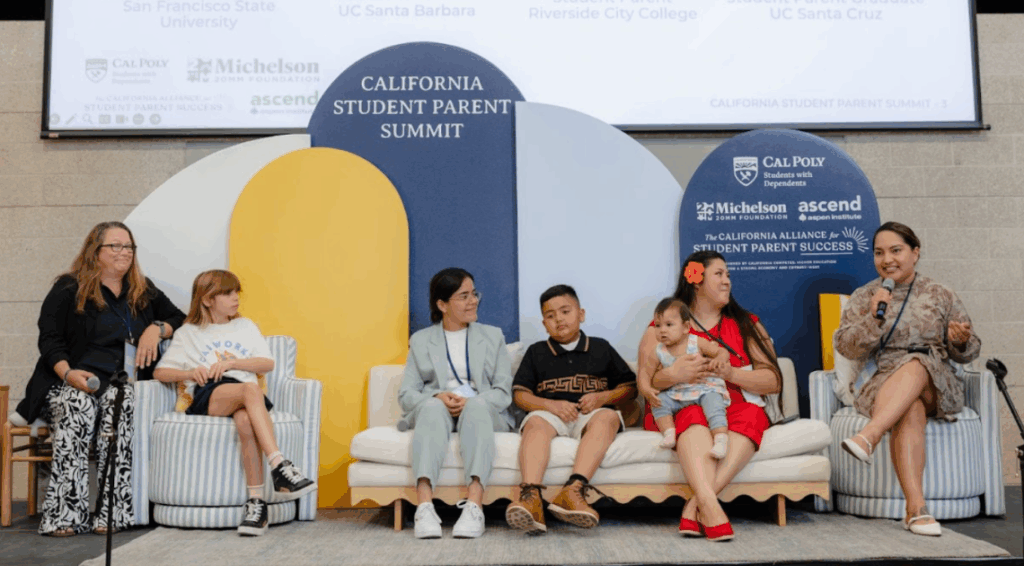
Parenting students share their experience at the Student Parent Summit
This year, Michelson 20MM advanced more equitable systems across California. The organization sponsored the biannual Student Parent Summit, now hosted by the California Alliance for Student Parent Success, which drew nearly 300 attendees. Through the Student Parent Pooled Fund, Michelson 20MM partnered with leading funders to strengthen campus supports and expand access to resources for student parents.
The team also elevated solutions to student housing insecurity as affordability challenges grew. With the Center for Equitable Higher Education, Michelson 20MM co-hosted a webinar on the three-year evaluation of the College Focused Rapid Rehousing strategy. At the same time, Michelson 20MM partnered with the Foundation for the Los Angeles Community Colleges to highlight co-housing models between two- and four-year institutions. These efforts helped lay policy foundations for future reforms and reinforced the commitment to evidence-based strategies and cross-sector collaboration.
Student Fellows Leading Change on Campus and Beyond
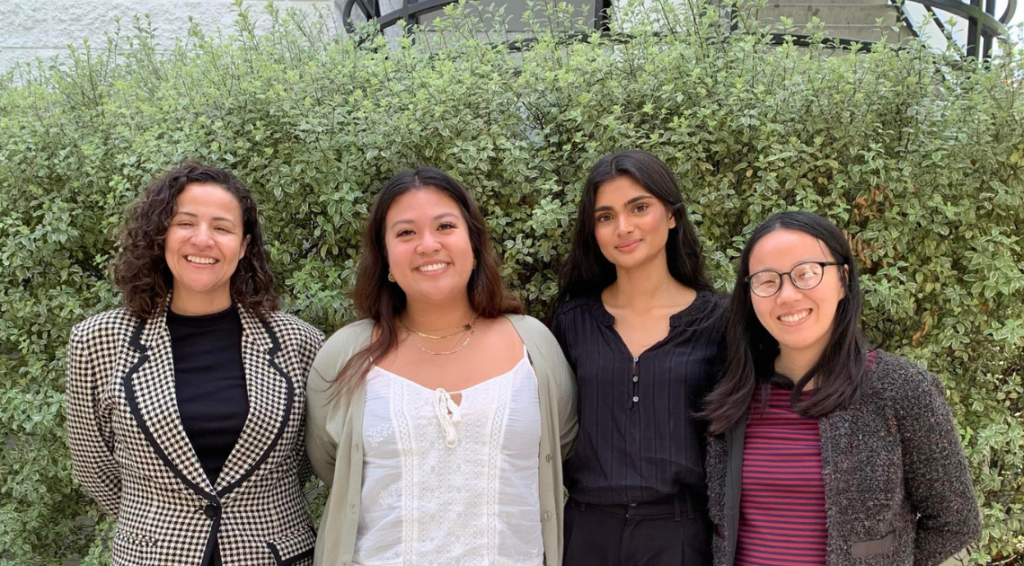
The 2025 Student Fellowship cohort
The 2025 Michelson 20MM Student Fellowship Cohort drove significant statewide policy and research efforts. Fellows elevated student perspectives in OER and ZTC work at the CCC ZTC Summit and advanced local consumer protection by challenging inequitable course-material fees. Across these efforts, fellows strengthened their influence in campus and statewide policymaking, while the Student Engagement team trained more than 30 emerging leaders at the CCC General Assembly.
Fellows are also producing research that will inform California’s future policy landscape. Their work will include a Transparency Report Card to track AB 607 compliance across CCC and CSU campuses; a public opinion poll on wages and labor conditions for incarcerated firefighters; a 2025 snapshot of digital access in Los Angeles County; and the development of a student-led definition of emergency aid, using campus survey data to shape California State University-wide recommendations. Together, these projects aim to advance evidence-based strategies and amplify student voices in statewide reform.
Michelson Intellectual Property Institute (Michelson IP): Expanding Access, Strengthening Pathways
Attendees gather at the California Invention Convention
The team also broadened national reach and strengthened educator support. Adoption of The Intangible Advantage through the partnership with OpenStax increased by 50%, signaling an increased interest in IP literacy in higher education. The team continued partnering with the Pro Bono Advisory Council to connect independent inventors with expert IP practitioners. At the same time, a Slack community for Educators in Residence was launched, the Learning Exchange was updated for easier access to free IP resources, and collaboration on new teaching tools was expanded. These efforts deepened Michelson IP’s impact and helped build a more inclusive innovation landscape.
Looking to 2026
As the team looks toward 2026, Michelson 20MM remains committed to advancing bold, equitable solutions that center students and strengthen educational opportunity. This year’s progress shows what is possible when philanthropy, research, and lived experience move in unison. We are grateful to our partners and community of advocates who make this progress possible, and we look forward to building on the momentum in the year ahead.
About Michelson 20MM
Michelson 20MM is a private, nonprofit foundation working toward equity for underserved and historically underrepresented communities by expanding access to educational and employment opportunities, increasing affordability of educational programs, and ensuring the necessary supports are in place for individuals to thrive. To do so, we work in the following verticals: Digital Equity, Intellectual Property, Smart Justice, Student Basic Needs, and Open Educational Resources (OER). Co-chaired and funded by Alya and Gary Michelson, Michelson 20MM is part of the Michelson Philanthropies network of foundations.
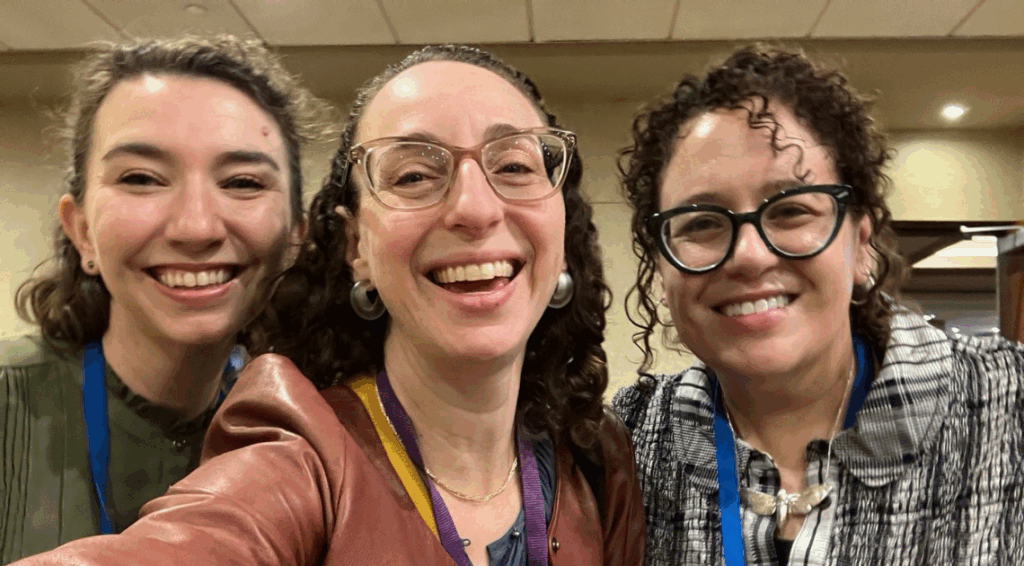
The Michelson 20MM Foundation proudly sponsored the 2025 Open Education Conference, the largest convening of open education practitioners and advocates in North America. The open education community met both online and in Denver to learn, build community, and renew our efforts towards creating a more equitable and accessible education system. Michelson 20MM was pleased to invite several members of the California OER community to attend the conference for free on the online track.
We look forward to taking the learnings from this event into the work we do this year and next. Those who attended both in person and online share their experience below.
Cailyn Nagle, OER Senior Program Manager, Michelson 20MM
In early October, it is easy to slip into the minutia of the work—wrapping up paperwork, finishing next year’s budget, and losing sight of the forest for the trees. OpenEd arrives at the perfect time to refocus on our purpose and the vibrant community making it possible.
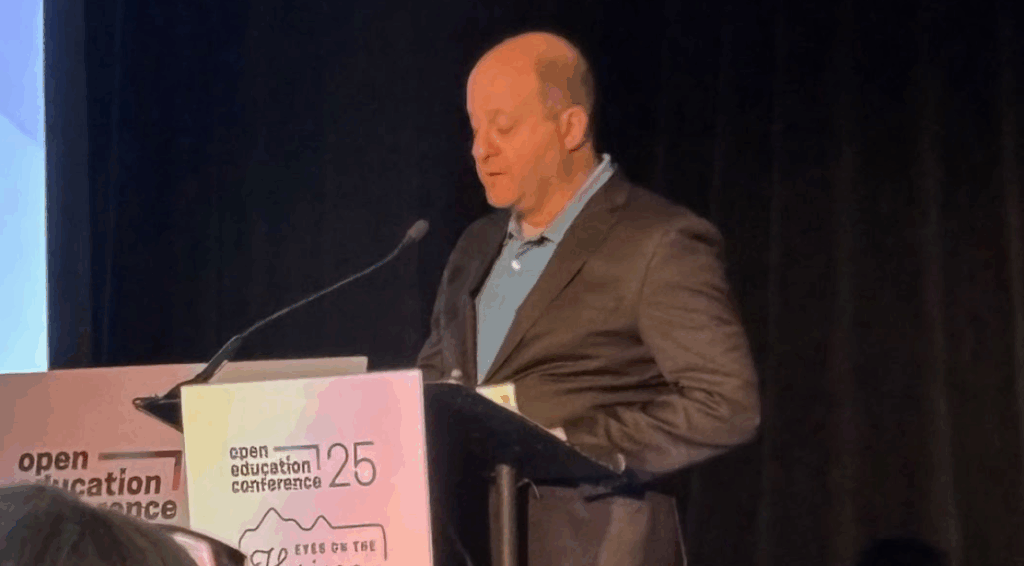
To kick off the conference, Governor Jared Polis celebrated Colorado’s Zero Textbook Cost programs and their positive impact on students. A couple of weeks later, he underlined this by including renewed funding for this program in his proposed budget. Moving from the institutional to the interpersonal, adrienne marie brown’s lunchtime plenary challenged participants to find personal authenticity while building bridges with those who have different perspectives.
Across three days, thousands of participants learned from practitioners, students, and researchers working on many areas of OER. The Scaling OER: Lessons from Five Statewide Grant Programs panel shared how five states—California, Colorado, Minnesota, New York, and Wisconsin—have approached open education and what they’ve learned. As someone working mainly in California, I found it fascinating to hear how others tackled similar goals with different challenges. Later that day, I also sat in on Alexander Karan’s presentation on the fantastic dashboard, which started as a Michelson 20MM Spark Grant–funded project that began at Chabot College and now operates on seven California Community College campuses. The data dashboard allows researchers to ask questions identifying potential impacts and gaps in the OER and Zero Textbook Cost programs.
The last session I attended was one I plan to rewatch with a pen in hand. During “A Positive Agenda for Open Education as Public Good,” we were called to be visionary about the future we want while taking actionable measures to set it up now. I plan to revisit many sessions I missed and re-watch several I attended. The Sched site now provides the recordings.
The OER Movement is more than materials or structures; it relies on the people who make it possible. Reconnecting with the open education community from across California and the country was an absolute joy. The importance of building and maintaining this community is immense, I am so grateful the conference makes this possible.
Marissa Martinez, Senior Coordinator of Student Engagement, Michelson 20MM
As the education landscape rapidly evolves, Open Educational Resources (OER) offer a transformative way to make learning more accessible, equitable, and adaptable. It’s important that we empower students to fight for OER on their campuses. This year’s conference ensured students could lead discussions on how they can contribute to the OER movement as creators and advocates.
The U.S. PIRG student textbook affordability panel demonstrated the power students have to fight for OER. Students recruited their peers, coordinated with faculty leaders, and lobbied at the state and national level for open textbooks. The keynote student panel reminded us that partnering with students is critical to shaping and strengthening the open education movement. OpenEd reaffirmed to many of us that students care about Open Education and are capable of fighting for it. We need to make sure we are effectively and proactively engaging them on our campuses.
Theresa Huff, OER for Social Justice Instructional Designer, Loyola Marymount University
Though attending and presenting virtually, I came into OpenEd looking for specific things and direction, rather than a casual exploration. As an OER Instructional Designer, who also teaches and researches around instructional design, AI, ethics, and learner well-being, I needed very specific tools, strategies, and ideas to inform my work. I also wanted guidance on how to sustain and protect our collective OER work in increasingly uncertain times. With funding shifts and political challenges on the horizon, I wanted to learn how others are building resilience and planning for the future of open education.
At OpenEd, I found what I was looking for and am still listening to more sessions! For example, the session on Recognizing, Rewarding, and Incentivizing Working with Open Educational Resources was a great modeling of using a designed, replicable roadmap to balance the intrinsic joy of open work with meaningful extrinsic rewards. I especially appreciated how the presenters used certificates and competencies to help faculty see and celebrate the skills they develop along the way. The presentation Let’s Read Together: Renewables for and by Business Undergrads About Business News sparked ideas for integrating AI-driven personalization and real-world application for use with my own students, connecting learning directly to students’ lived experiences. An unexpected, interesting session on Federated Open Learning Resources expanded my view of how decentralized networks might preserve and safeguard OER against institutional or political volatility. They can even do so while enhancing global accessibility and community. Though each session offered a piece of what I needed, I’m looking forward to continuing to sip on the other recorded sessions in the weeks ahead. It was such a lift to protect and reimagine what openness can mean in future practice by inspiring each other.
Looking Ahead
As we reflect on the rich conversations, bold ideas, and renewed sense of purpose that emerged from this year’s Open Education Conference, we are reminded of the collective power of this community and the shared commitment that drives it forward. The insights gathered will continue to inform and strengthen our work in the months ahead. Michelson 20MM remains deeply grateful for the opportunity to learn alongside so many dedicated practitioners and to support the growing movement for accessible, equitable, and student-centered education. Together, we will keep building a future where open education is a reality for all.
About the Michelson 20MM Foundation
Michelson 20MM is a private, nonprofit foundation working toward equity for underserved and historically underrepresented communities by expanding access to educational and employment opportunities, increasing affordability of educational programs, and ensuring the necessary supports are in place for individuals to thrive. To do so, we work in the following verticals: Digital Equity, Intellectual Property, Smart Justice, Student Basic Needs, and Open Educational Resources (OER). Co-chaired and funded by Alya and Gary Michelson, Michelson 20MM is part of the Michelson Philanthropies network of foundations.
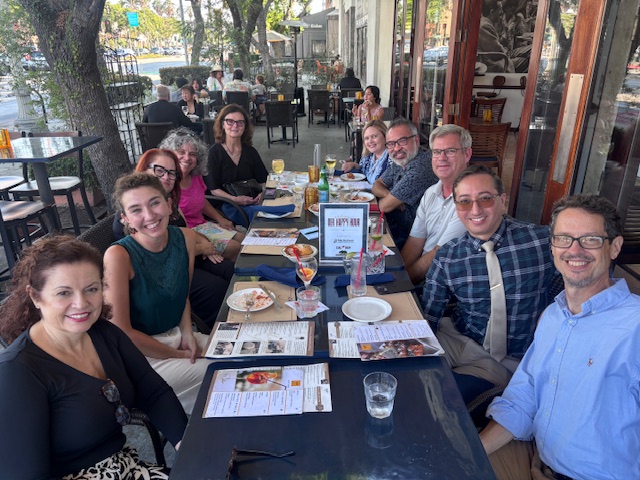
This August, the California OER Conference offered both an opportunity to learn from practitioners and a chance to build community. While much of the conference took place online, the Michelson 20MM Foundation was happy to sponsor the conference and host two regional, in person happy hours.
Kicking Off: Keynotes and Collaboration in Culver City
The evening before the start of the event, faculty, administrators, and advocates from across Southern California joined us for the first happy hour. The California OER community has made tremendous strides driven by the strong spirit of collaboration cultivated across the OER ecosystem. Luckily, sometimes that collaboration can also include collaborating to eat some pizza.
Dr. David Wiley kicked off the conference Wednesday morning with the first keynote of the event, during which he shared his perspective on AI, OER sustainability, and the future of open education. Dr. Wiley, founder of Lumen Learning, which provides low cost course materials through leveraging high quality OER, helped shape the open education movement and authored the influential 5 Rs of OER.
Thursday’s keynote, “The Future of Equity in OER Amid a Shifting Landscape,” pulled voices from across the country together. They shared an important and challenging conversation about the shifting national landscapes’ impact on the field. Open education practitioners approach the work from different contexts and perspectives, but are unified in the desire to build a better future for students and educators alike. Amid recent unprecedented scrutiny and challenges, hearing from OER practitioners dedicated to centering the needs of students within this atmosphere was an invaluable contribution to the conference.
Highlighting Michelson 20MM Spark Grantees and Other Sessions
The conference’s sessions ranged from updates on projects to new research and case studies. While focusing on California, the conference included participation from Connecticut, Florida, and Texas. Two strong currents throughout the conference were an interest in AI and the ongoing impact of the California Community College’s (CCC) Zero Textbook Cost (ZTC) program.
AI was covered from multiple angels beyond the keynote including best practices, a survey of trends and preferences, and multilingual education. Over the two and a half days of the conference, six AI related sessions were offered, which shows a strong interest from practitioners and the field. During Bay View’s session, which previewed their newest national survey, they shared that 62% of California faculty and 87% of California’s students reported using the technology.
The other strong thread woven throughout the event was the ongoing impact of the ZTC programs growing across the CCC system. With most ZTC programs using OER to bring their textbooks costs to zero, it is no surprise that the project, now in its final funding phases with hundreds of degree programs underway, has garnered deserved attention. Some of the sessions focused on providing updates on the progress of the system-wide effort while others gave a peak into more regional projects. The presenters from Chabot College gave an update on a multi-campus effort to build a dynamic dashboard created from diverse sets of data that shows the impacts, gaps, and outcomes of ZTC efforts. The dashboard, funded through a Michelson 20MM Spark Grant, has gained momentum with new campuses signing on to participate. Irvine College also featured another Spark Grant-funded ZTC program that investigates how students find and access ZTC efforts.
Beyond these themes, the Systems Update from the University of California (UC), the California State College and University (CSU), and the CCC offices shared the upcoming open education projects, challenges, and direction the largest systems of higher education in the country are considering. Other sessions took a more detailed look at issues facing institutions of higher learning, such as automatic textbook billing. Additionally, faculty from Eastern Connecticut State University sharing new research in their session ‘Is Automatic Textbook Billing Beneficial for Your Institution? A Case Study.”
Closing Out with Camaraderie in Oakland
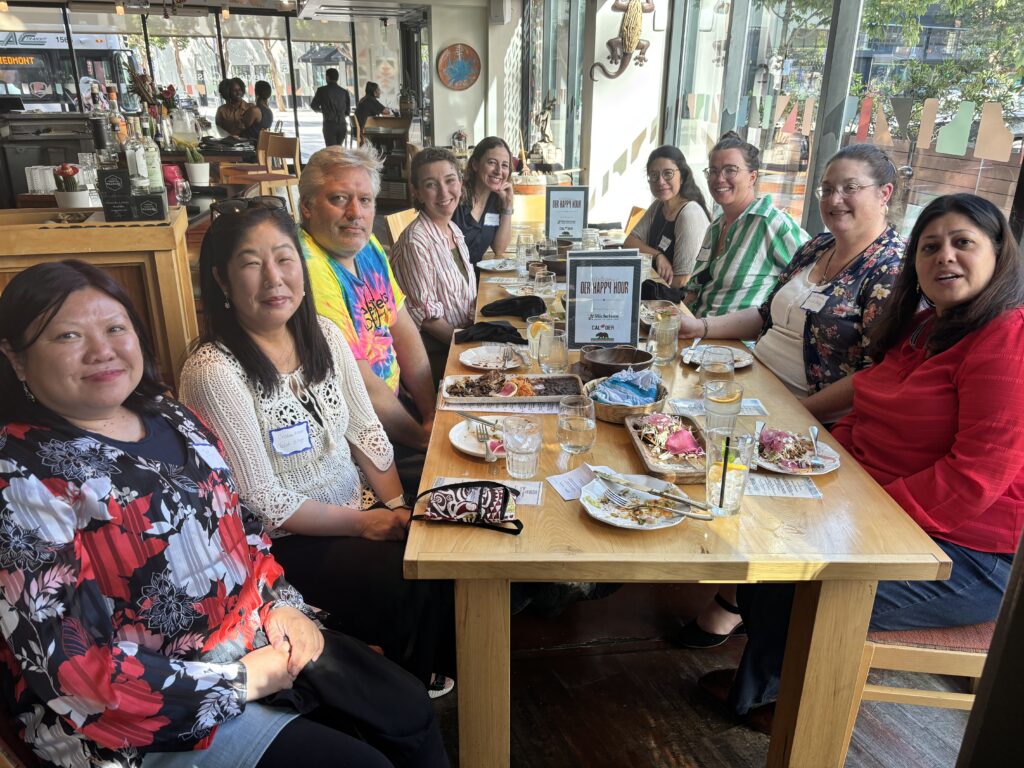
Educators and open community members from CCC, UC, and local private colleges closed the conference in Oakland at the second Michelson 20MM OER Happy Hour. While we have been happy to host four previous similar events in Los Angeles, this was our first in the Bay Area. With guests coming in on trains, carpools, and around the block, we are deeply grateful to all who attended the event. While open education is a growing field, and much larger than even just a few years ago, many OER practitioners often feel siloed in their work. That makes building community and connections a vital part of creating the thriving and sustainable OER ecosystem we need. We are honored to be part of building that community.
Michelson 20MM Foundation
Michelson 20MM is a private, nonprofit foundation working toward equity for underserved and historically underrepresented communities by expanding access to educational and employment opportunities, increasing affordability of educational programs, and ensuring the necessary supports are in place for individuals to thrive. To do so, we work in the following verticals: Digital Equity, Intellectual Property, Smart Justice, Student Basic Needs, and Open Educational Resources (OER). Co-chaired and funded by Alya and Gary Michelson, Michelson 20MM is part of the Michelson Philanthropies network of foundations.
Across California, faculty members are embracing Open Educational Resources (OER) to reduce students’ costs and increase their access. As OER gains prominence, many instructors face a familiar challenge: How to effectively communicate the value of OER to their students, colleagues, and institutions.
Faculty who run OER programs often create exciting programs with little support for sharing their work. They write, revise, and implement new materials, but lack the marketing tools to help others understand the impact. Loyola Marymount University (LMU) understands that without awareness and visibility, even the most transformative OER can remain underused.
The Toolkit Filling the Gap
With a 2025 Michelson Spark Grant, LMU is addressing that gap. They will develop an openly licensed OER for Social Justice Marketing and Advocacy Toolkit. The toolkit will offer ready-to-use, customizable materials that faculty, students, and staff can use to promote and sustain OER adoption.
These resources aren’t one-size-fits-all. They’re designed with California’s diverse institutions in mind. The toolkit includes:
A Faculty Promotion Kit to support faculty in advocating for their adoption, adaptation, and creation of OER
An Awareness and Engagement Kit to engage students and faculty in OER adoption through interactive and visually compelling materials.
Everything will be adaptable. Institutions can contextualize materials to reflect their mission, values, and student populations.
Co-Created with Students, Built for Community
What sets this project apart is its emphasis on collaboration. Students will play a key role in shaping the toolkit by supporting graphic design and video storytelling, among other roles. LMU’s approach shifts away from top-down advocacy models, instead centering student creativity and voice.
This hands-on, participatory model reflects the values at the heart of OER: access, agency, and shared ownership. “We’re not just promoting OER, we’re building infrastructure that supports it long-term,” said Cailyn Nagle, Senior Program Manager for OER at Michelson 20MM. “This toolkit will give faculty and students what they need to keep the movement going, together.”
Designed for Impact and Built to Last
The project will pilot with LMU’s existing OER faculty teams and then scale through partnerships with the Southern California Electronic Library Consortium (SCELC). Materials will be housed in the OER for Social Justice Handbook and made freely available for adaptation. At the same time, trainings and workshops across the state will help campus leaders use the toolkit in real time. LMU’s efforts will foster professional development, peer support, and new collaborations.
By investing in visibility, this project helps institutions recognize and reward OER work. It supports faculty who want to integrate OER into tenure conversations and gives students the tools to become advocates on their own campuses. Most importantly, it ensures that OER continues to grow not just as a set of resources, but as a movement rooted in equity, inclusion, and shared success.
About Michelson 20MM Foundation
Michelson 20MM is a private, nonprofit foundation working toward equity for underserved and historically underrepresented communities by expanding access to educational and employment opportunities, increasing affordability of educational programs, and ensuring the necessary supports are in place for individuals to thrive. To do so, we work in the following verticals: Digital Equity, Intellectual Property, Smart Justice, Student Basic Needs, and Open Educational Resources (OER). Co-chaired and funded by Alya and Gary Michelson, Michelson 20MM is part of the Michelson Philanthropies network of foundations.
Irvine Valley College (IVC) wants to improve how students find, navigate, and complete Zero Textbook Cost (ZTC) Degrees through a Michelson Spark Grant. IVC is investigating the best way to design a system centered on the student experience. The goal is to make ZTC pathways user-friendly, easy to identify, accessible, and practical.
Centering Students in ZTC Innovation
IVC is asking: How are students being directed to these resources? Are the instructions clear, and can a student realistically navigate and access what the institution claims to offer?
“Everyone wants ZTC degrees to benefit students, but learning how to maximize those benefits is going to take research and hard work,” said Cailyn Nagle, OER Senior Program Manager at Michelson 20MM. “This project will offer insights for colleges statewide that are building ZTC Degrees.” The study will identify what students need to access and complete ZTC pathways. It will also analyze how ZTC options are presented online and which tools students find most helpful.
The Role of Students in the Research
IVC will engage students as research partners throughout the project. Using a tiered model, students will lead focus groups, administer survey collection, analyze data, co-author findings, and present results at statewide conferences. The project offers participation options ranging from one-time involvement to full-semester engagement.
Delivering Actionable Research and Resources
The research will produce a detailed report with student-driven findings and recommendations. It will include a preliminary plan to build a student-friendly ZTC Degree interface. Additionally, the project will develop materials that can be shared widely. These outputs will guide IVC’s future ZTC planning and support similar efforts at other colleges.
Commitment to Equity and Inclusion
IVC serves a diverse student body, including many first-generation and working students. The project reflects their commitment to equity by embedding student perspectives throughout the research process. It encourages ZTC pathways that are clear, current, and centered on what students actually need.
Looking Ahead: A Scalable Model for ZTC Degrees
The Michelson Spark Grant will support research during the academic year. After that, IVC will share its findings broadly across California’s community college system. The project aims to document what works in ZTC implementation and why. IVC hopes to help shape a future where all students earn degrees without costly textbooks. Ultimately, they will influence how colleges design, communicate, and operationalize ZTC pathways to benefit.
About the Michelson 20MM Foundation
Michelson 20MM is a private, nonprofit foundation working toward equity for underserved and historically underrepresented communities by expanding access to educational and employment opportunities, increasing affordability of educational programs, and ensuring the necessary supports are in place for individuals to thrive. To do so, we work in the following verticals: Digital Equity, Intellectual Property, Smart Justice, Student Basic Needs, and Open Educational Resources (OER). Co-chaired and funded by Alya and Gary Michelson, Michelson 20MM is part of the Michelson Philanthropies network of foundations.
Earlier this month, the Michelson 20MM Foundation joined faculty, administrators and researchers at the Zero-Textbook Cost (ZTC) Degree summit hosted by College of the Canyons. Over a hundred ZTC and OER practitioners gathered to learn about efforts to lower course material costs in California Community Colleges (CCC).
A Statewide Commitment to Affordability
In 2021, Governor Newsom allocated $115 million to fund the current ZTC Degree program, the largest single investment in course material affordability nationally. “ZTC Degrees” are degree programs composed entirely of courses that eliminate textbook costs by using high-quality, no-cost content, with an emphasis on OER. The program builds on a 2016 pilot that created 33 ZTC Degrees and Career Technical Education certificates at 23 CCCs, saving students $7 for every $1 invested.
Celebrating Progress and Looking Ahead
The morning kicked off with welcoming remarks from Hildegarde B. Aguinaldo, president of the CCC Board of Governors, and David Andrus, interim president of the College of the Canyons.
Following the welcome, the Office of the Chancellor’s update provided a lot of news worth celebrating! They shared that the program has successfully allocated the majority of their funding and that 379 ZTC pathways will be available across the system by this fall’s term. The positive impact this has on accessibility across the system will be immediately felt by students. These programs will launch this fall, with even more ZTC degrees under development. After hearing such inspiring progress, the event split into breakout sessions on topics like AI in OER, ZTC and general education, and OER and ZTC Advocacy.
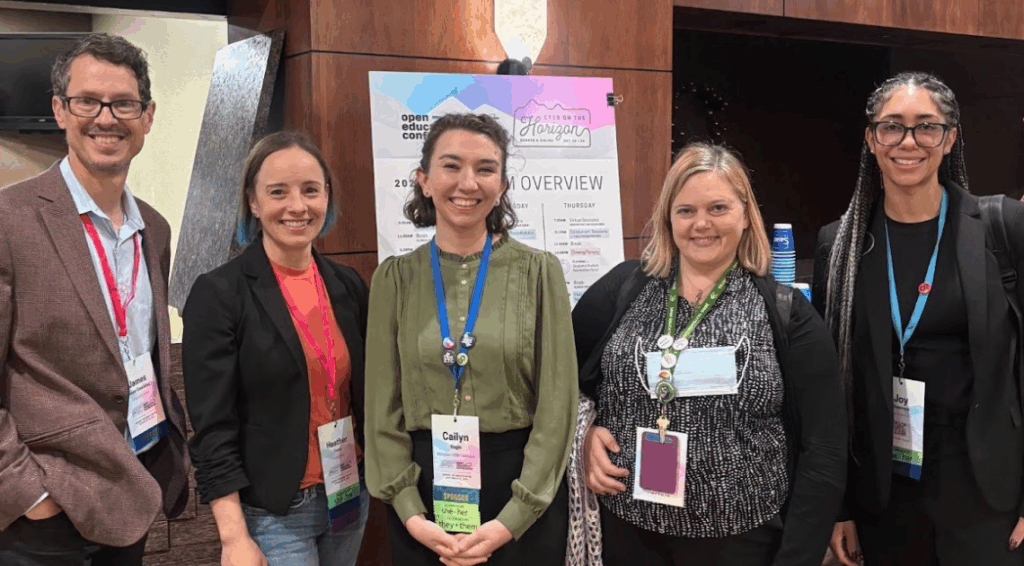
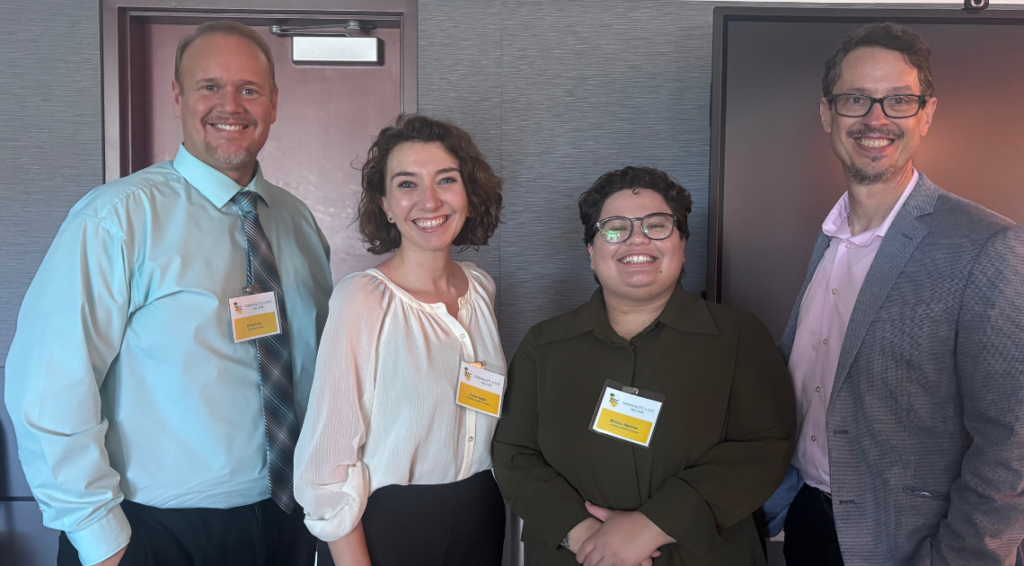
Left to right: Chad Funk, Cailyn Nagle, Marissa Martinez, and James Glapa-Grossklag at the ZTC Summit
“Effective Approaches to Engaging Students in OER/ZTC Efforts,” a session led by Marissa, was filled with campus faculty, librarians, and administrators. They were eager to learn more about how they could best engage students to support OER and ZTC advocacy. The presentation encouraged participants to use an advocacy framework when thinking about ways to partner with students for their OER projects.
Each session group discussed their project goals, strategies, and tactics to understand where students can most effectively support their OER and ZTC efforts. Participants learned about some of the tactics student-leadership can use to further the goals of their campaigns like writing resolutions or hosting on-campus events. By the end of the sessions, attendees were left with a campus-specific OER/ZTC advocacy strategy, a strategic understanding of the role students play as partners in the work, and the tactics students can use to push the needle forward on OER adoption and ZTC degree implementation.
Faculty Leadership and Systemwide Momentum
Michelle Pilati, Psychology Professor at RioHondo College and Project Director of the Academic Senate’s Open Educational Resource Initiative (OERI), led the keynote session. She outlined the fantastic work faculty have done across the state, from curating OER collections to supporting OER liaisons across colleges. OERI plans to continue supporting OER development, cross-discipline sessions, and provide professional development opportunities for CCC educators. They will also continue to advocate for and support the implementation of open course materials across the system for at least another decade.
Innovative Tools and Local Success Stories
The day wrapped up with individual colleges digging into their local success stories, projects, and research, including Michelson 20MM Spark Grant recipients from Chabot College. Colleges like Coalinga, Diablo Valley, Leemore, and Mira Costa Colleges shared more about the strategies they have taken locally to build successful ZTC programs. This includes focusing on full-time faculty outreach as a point of programmatic sustainability to evaluating the negative impacts high textbook costs have on students.
Chabot College gave an in-depth preview of the interactive data dashboard built over the last year. Nine colleges are currently piloting the dashboard, which helps ZTC programs to identify gaps in their pathways, track impacts on students, and more. The room was buzzing with excitement as Dr. Alexander Karan, who played a large role in building the system, gave a tour of the program. It’s rare to get “oohs and aahs” from an audience looking at graphs, but the Chabot team certainly earned and received them.
A Call to Keep Building
It is not easy to build something as large, interconnected, and visionary as Zero Textbook Cost Degrees, but educators across California are doing just that. Librarians, administrators, instructors, researchers and others will continue the hard work of lowering costs for students and increasing access to course materials. The State of California must rally behind those who are rolling up their sleeves to support students throughout this system and beyond. We must support those who are building a higher education system that reflects the equity and opportunity our state deserves.
About the Michelson 20MM Foundation
Michelson 20MM is a private, nonprofit foundation working toward equity for underserved and historically underrepresented communities by expanding access to educational and employment opportunities, increasing affordability of educational programs, and ensuring the necessary supports are in place for individuals to thrive. To do so, we work in the following verticals: Digital Equity, Intellectual Property, Smart Justice, Student Basic Needs, and Open Educational Resources (OER). Co-chaired and funded by Alya and Gary Michelson, Michelson 20MM is part of the Michelson Philanthropies network of foundations.
College textbooks remain unaffordable for many students. There is a solution, though. OER reduces costs, increases flexibility, and lets students take ownership of their learning. The student perspective, however, often remains underrepresented in OER adoption efforts.
A Regional Fellowship for OER Advocacy
CSU Dominguez Hills is changing that. The university will lead a regional OER student advocacy fellowship in partnership with:
CSU Channel Islands
CSU Fullerton
Cal State LA
Cal State Northridge
Through this project, each campus will hire one student fellow to lead local outreach and advocacy.
Empowering Students to Lead
Fellows will promote OER and Zero-Cost Course Materials through events, peer engagement, and collaboration with faculty and staff. They will also work together as a community of practice, sharing strategies and supporting one another throughout the year. At the same time, fellows will receive training and mentorship from the campus Affordable Learning Solutions (AL$) coordinators.
“Students have the power to drive OER adoption and shape policy across their own campuses, but need support and resources to do so,” said Cailyn Nagle, Senior Program Manager for OER at Michelson 20MM. “Fellowships like this one create lasting, student-driven change.”
Scaling for Systemwide and Statewide Impact
The project has potential for systemwide impact. Since the CSU AL$ coordinators meet monthly, there is an organic platform to scale the model across all CSU campuses. The CSUDH team also anticipates that there will be opportunities to present at national OER conferences.
This program will directly impact students at five minority serving institutions in Southern California. These campuses serve over 121,000 students, who will benefit from affordable, accessible course materials.
To measure success, the team will track:
Hiring and training five fellows and launching a shared outreach strategy
Student and faculty engagement, including coordination with the CA State Student Association
Campus resource mapping to sustain OER advocacy beyond the grant period
This project aims to become a model for student-driven OER advocacy throughout California and nationwide. By centering students, this initiative promotes equity, leadership, and lasting systems change. Stay tuned for more in the coming year.
About the Michelson 20MM Foundation
Michelson 20MM is a private, nonprofit foundation working toward equity for underserved and historically underrepresented communities by expanding access to educational and employment opportunities, increasing affordability of educational programs, and ensuring the necessary supports are in place for individuals to thrive. To do so, we work in the following verticals: Digital Equity, Intellectual Property, Smart Justice, Student Basic Needs, and Open Educational Resources (OER). Co-chaired and funded by Alya and Gary Michelson, Michelson 20MM is part of the Michelson Philanthropies network of foundations.
Michelson 20MM is thrilled to announce the 2025 Open Educational Resources (OER) Spark Grantees: California State University Dominguez Hills, Irvine Valley College, and Loyola Marymount University! Their innovative projects will advance the following focus areas:
Improve the quality and reach of OER marketing materials, particularly for under-resourced programs.
Mobilize students and faculty to pass OER policies at the University of California (UC), California Community Colleges (CCC), and California State University (CSU) systems.
Support the implementation of California’s investment in zero-textbook-cost (ZTC) degree programs within the CCC system.
Meet the Grantees and Their Projects
California State University Dominguez Hills (CSUDH) will launch a student fellowship program across five CSU campuses. Building on the Affordable Learning Solutions (AL$) Program, they will empower students to advocate for OER by promoting benefits including cost savings, flexibility, and student success. Students will collaborate, share strategies, and advocate for OER adoption and policy changes. Beginning at five campuses, the project has the potential to scale statewide, benefiting hundreds of thousands of students.
Irvine Valley College (IVC)’s project will seek to improve the student-facing experience of ZTC degree pathways. Making ZTC degrees easy to navigate and accessible is not easy, relying on often disjointed data and limited resources. This project will focus on understanding the challenges students face through qualitative research, including surveys and focus groups. By collecting data from students and involving them as research partners, the initiative will study what it would take to create a practical, student-centered ZTC system that can be scaled across institutions. The project also aims to integrate findings into a clear, actionable plan for creating accessible, transparent, and sustainable ZTC pathways that can enhance student success and OER adoption statewide.
Loyola Marymount University’s (LMU’s) OER for Social Justice Marketing and Advocacy Toolkit will build and diffuse customizable marketing materials for promoting OER at under-resourced institutions. The project will produce two adaptable OER marketing kits: one designed to help faculty advocate for OER adoption and another aimed at educating both faculty and students about OER’s benefits. Students will actively co-create content, participate in focus groups, and contribute to education campaigns, using proven advocacy methods. By centering student voices and adaptable messaging, the toolkit will be relevant across different institutional types.
Why OER Matters
OER allows for greater flexibility in teaching and learning, while empowering students to take control of their education. As Cailyn Nagle, Senior Program Manager for OER, shared, “OER not only lowers costs but also transforms the educational experience by providing students with more accessible, flexible, and relevant learning materials.” By promoting OER adoption and advocacy, these projects help bridge gaps in educational access and equity across California’s diverse institutions and beyond.
Learn More
We look forward to sharing more about the impact of these projects as they build on the future of affordable and accessible education for all students.
About the Michelson 20MM Foundation
Michelson 20MM is a private, nonprofit foundation working toward equity for underserved and historically underrepresented communities by expanding access to educational and employment opportunities, increasing affordability of educational programs, and ensuring the necessary supports are in place for individuals to thrive. To do so, we work in the following verticals: Digital Equity, Intellectual Property, Smart Justice, Student Basic Needs, and Open Educational Resources (OER). Co-chaired and funded by Alya and Gary Michelson, Michelson 20MM is part of the Michelson Philanthropies network of foundations.