
By Sergio Rodriguez Camarena
Accelerating Economic Opportunity for Justice-Involved Populations By Investing in Workforce Development
Affordability has become the central issue in California’s 2026 policy agenda and the dominant concern shaping voter decisions in the state’s 2026 primary elections. California consistently ranks as one of the least affordable states in the U.S. due to its high cost of living and chronic housing shortage. Solving the crisis will take more than housing policy alone – it requires expanding access to stable, well-paid jobs that let people actually afford to stay in the state they call home. That is especially true for one of California’s most economically-excluded populations: people with a history of incarceration, who face some of the steepest barriers to employment and as the Public Policy Institute of California finds, double the average number of regulations affecting employment than any other state.
This is why over the course of the next year, Michelson 20MM is strengthening our commitment to economic justice as a driving force behind our work. We recognize the barriers that continue to stand between Californians and economic security, and we believe every Californian deserves to have the resources and opportunities that make economic stability and mobility possible. In practice, that means identifying those barriers and solutions to employment through our partners and our annual Smart Justice Spark Grants and pursuing policy action, whenever possible, via the Michelson Center for Public Policy, to scale up those solutions.
Most recently, in partnership with the Vera Institute of Justice and NextGen California, the Michelson Center for Public Policy co-sponsored the Jails to Jobs (J2J) pilot program that would connect people charged with low-level, nonviolent offenses to job training and employment pathways in high-demand fields like healthcare and the skilled trades. The goal is simple: to help build financial stability soon after an arrest while strengthening California’s workforce in sectors that need workers.

That approach just received a major vote of confidence from the Golden State. Recently, Governor Newsom signed the state budget for Fiscal Year 2026-27, which includes a $5 million initial investment in Jails to Jobs. The funding will support an education campaign in Los Angeles County to help people navigate the legal system and employers better understand employment opportunities and hiring for people with pending court cases. This is public dollars betting on the same premise J2J was built on: that access to a well-paid and stable job reduces recidivism and delivers public safety, while building out a more economically strong and resilient California.
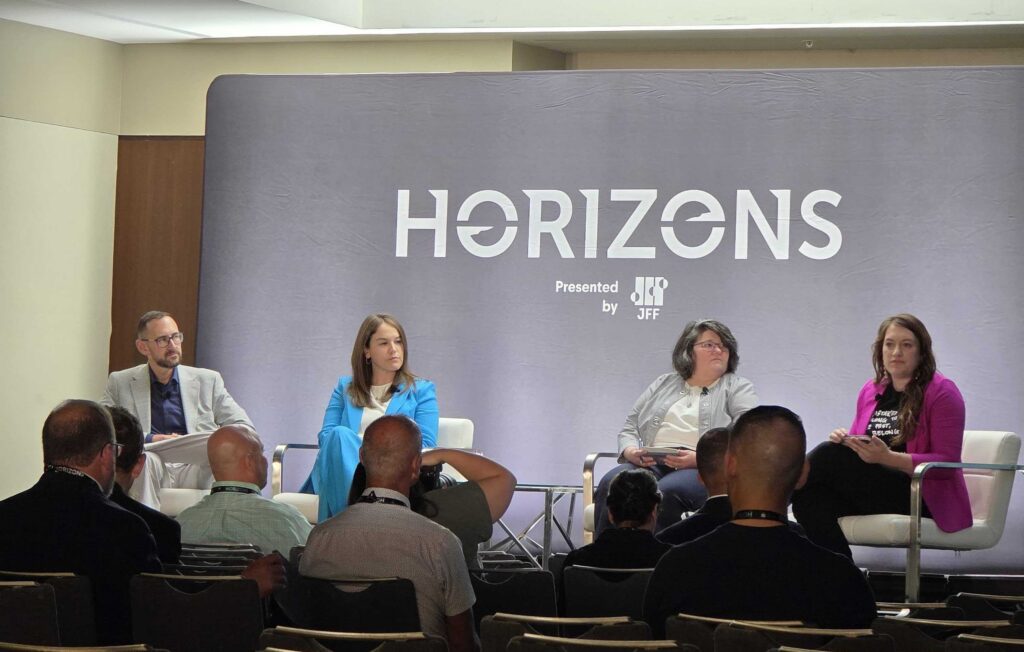
As part of Michelson 20MM’s ongoing commitment to workforce development pathways, I attended the 2026 Horizons Summit in Washington, D.C. – a gathering that brings together employers seeking workforce solutions, investors funding the future of work, government leaders shaping workforce policy, entrepreneurs reimagining education and training, and education and workforce development providers delivering opportunity to those who need it most. The summit was convened by Jobs for the Future (JFF), a recipient of one of our 2025 Smart Justice Spark Grants. I spent most of my time in the “Fair Chance” track, led by JFF’s Center for Justice & Economic Advancement, which is wrestling with a similar question: how do we connect more formerly-incarcerated individuals with well-paying, stable jobs?
A few themes and learnings resonated with me:
- “Fair Chances” vs. “Second Chances”
- I was struck to learn the difference between “fair” and “second” chances. “Fair chance” targets the system: the rules that filter people out before they can be judged on their current skills. “Second chances” targets the individual: the narrative that someone made a mistake and now deserves mercy. Advocates are increasingly gravitating toward “fair chance” language because it frames opportunity as a right rather than an act of charity, and because it locates the barrier in the system rather than in the person.
- I was struck to learn the difference between “fair” and “second” chances. “Fair chance” targets the system: the rules that filter people out before they can be judged on their current skills. “Second chances” targets the individual: the narrative that someone made a mistake and now deserves mercy. Advocates are increasingly gravitating toward “fair chance” language because it frames opportunity as a right rather than an act of charity, and because it locates the barrier in the system rather than in the person.
- Fear drives many of the barriers to employment
- Some of the biggest challenges in this space are countering the myths and stigma around hiring justice-involved populations. Countering the fear/stigma will require a concerted effort using data, narrative change, and policy action – and more importantly, trust and relationship-building across differences.
- Some of the biggest challenges in this space are countering the myths and stigma around hiring justice-involved populations. Countering the fear/stigma will require a concerted effort using data, narrative change, and policy action – and more importantly, trust and relationship-building across differences.
- What’s missing in this ecosystem is alignment, not commitment
- Plenty of stakeholders are working to expand pathways from incarceration to quality jobs, but the momentum is stalled by siloed efforts. JFF’s Center for Justice & Economic Advancement identified eight core partners/stakeholders who need to be at the table to help move this work forward:
- Departments of corrections and community supervision
- Postsecondary education and workforce training providers and system offices
- Workforce development agencies and workforce boards
- State leaders and policymakers
- Systems-impacted leaders, including people with lived experience of incarceration
- Employers, industry organizations, and unions
- Community and advocacy organizations
- Providers of reentry, legal, and social benefit services
- Plenty of stakeholders are working to expand pathways from incarceration to quality jobs, but the momentum is stalled by siloed efforts. JFF’s Center for Justice & Economic Advancement identified eight core partners/stakeholders who need to be at the table to help move this work forward:
- Better data is needed to show a positive return on investment
- More than ever, these workforce development programs are asked to show a positive return on investment (ROI); in essence, answering the question of whether these programs lead to increased job placement, increased wages, long-term and stable employment, reduced recidivism, etc. Demonstrating a positive ROI will increase buy-in across every stakeholder group.
Most of the sessions focused on currently and formerly incarcerated people, but I kept thinking about the populations upstream of that involvement with the criminal legal system: communities that are over-policed, over-criminalized, and under-invested in, who are at the highest risk of incarceration in the first place.
If we can build stable pathways for people before they’re ever justice-involved, we can prevent the harm before it happens.
That’s why I believe every stakeholder who is leading workforce development strategies for currently and formerly incarcerated individuals also needs an early-intervention component that provides communities with a “first chance.”
Ultimately, these findings reinforce where we need to go as a state: investing in the future of public safety means investing in an inclusive economy, one where every community can live and thrive in California.
About the Michelson 20MM Foundation
Michelson 20MM is a private, nonprofit foundation working toward equity for underserved and historically underrepresented communities by expanding access to educational and employment opportunities, increasing affordability of educational programs, and ensuring the necessary supports are in place for individuals to thrive. To do so, we work in the following verticals: Digital Equity, Intellectual Property, Smart Justice, Student Basic Needs, and Open Educational Resources (OER). Co-chaired and funded by Alya and Gary Michelson, Michelson 20MM is part of the Michelson Philanthropies network of foundations.